
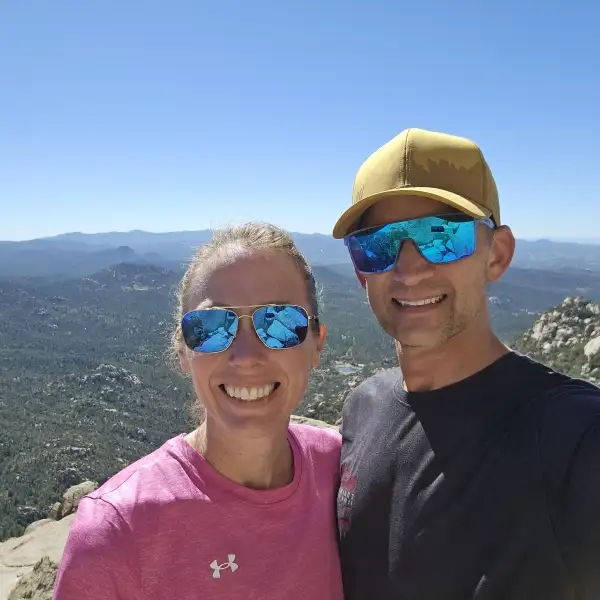
You’ll find Thumb Butte standing proudly just west of downtown Prescott, offering one of Arizona’s most rewarding quick hikes. This iconic granite landmark has welcomed hikers for generations, but there’s more to it than meets the eye. Before you lace up your boots and hit the trail, you’ll want to know about seasonal closures, the two distinct routes up, and why Wednesdays might be your best day to visit.
Driving Directions and Parking at Thumb Butte Trailhead
Getting to Thumb Butte Trailhead is straightforward and scenic! From downtown Prescott’s Courthouse Plaza, head west on Gurley Street. It becomes Thumb Butte Road (County Road 65) as you drive 3–5 miles through residential areas into Prescott National Forest.
You’ll find a well-developed parking lot at the Thumb Butte Recreation Area. There’s ample space, though weekends and peak seasons fill up fast—arrive early for guaranteed spots! The day-use area requires a $5 parking fee supporting trail maintenance.
You’ll enjoy convenient restrooms and helpful information kiosks near the trailhead. The kiosks provide trail maps for planning your route. The parking area serves multiple trails and picnic sites, so expect fellow adventurers.
Check weather conditions before heading out, especially in winter. The road handles passenger vehicles easily under normal conditions.
Thumb Butte Trail Distance, Elevation Gain, and Hiking Time
Once you’ve parked and prepped your gear, you’re ready to tackle this rewarding loop! The Thumb Butte Trail #33 covers approximately 2.0 miles around the butte’s base, though you’ll see some sources list it as 2.1 to 2.5 miles depending on variations. You’ll climb about 600–613 feet of elevation gain, which feels like ascending 43 stories!
Most hikers complete the loop in 1–2 hours, though speedier adventurers finish in under an hour. The trail starts at 5,694 feet and reaches roughly 6,318 feet at its high point, offering spectacular views of the San Francisco Peaks and Granite Mountain. You’ll find benches at lookout points where you can rest and soak in the panoramic mountain vistas.
The moderate difficulty means you’ll work up a sweat without needing technical skills—perfect for a satisfying morning workout!
Parking Fees, Free Wednesdays, and Trailhead Amenities
Before you hit the trail, you’ll need to budget for the $5 day-use parking fee at Thumb Butte Recreation Area. You can pay with a card right at the trailhead. Here’s a money-saving tip: visit on Wednesdays for completely free parking! This popular program has been helping budget-conscious hikers since April 2018.
The recreation area sits about 3.4 miles west of downtown Prescott via Gurley Street, which turns into Thumb Butte Road. You’ll find two convenient parking lots when you arrive, with Trail No. 33’s trailhead located across from the main lot.
You’ll appreciate the excellent facilities here, including flush toilets, potable water, and plenty of picnic tables. Educational plaques and interpretive signs along the trail enhance your hiking experience. While there are no food services available directly at the trailhead, you should bring your own snacks and water for the hike.
East Side vs. West Side: Which Route to Take?
The Thumb Butte loop offers two distinct personalities depending on which direction you tackle it. Going counterclockwise up the east side hits you with a steep, paved climb—700 feet of elevation gain packed into less than a mile. It’s a legitimate workout that’ll get your heart pounding fast. The west side spreads that elevation over gentler grades along a natural dirt path, perfect for casual hikers and families.
Most experienced hikers climb the east side and descend the west. Why? That lumpy pavement feels jarring on your knees coming down, while the west’s softer dirt surface absorbs impact beautifully. You’ll also hit the stunning Groom Creek Vista faster going counterclockwise, then enjoy shaded forest and manzanita groves on your descent. Along the way, educational signs provide information about local plants and forest ecology.
What to Bring: Footwear, Water, and Sun Protection
Smart preparation turns a gorgeous day hike into a comfortable, safe adventure—and it starts with what you bring. Wear sturdy hiking boots with ankle support and aggressive tread for those steep, rocky sections. Trail runners work but increase ankle-roll risk on descents. Pack moisture-wicking socks to prevent blisters during the 2.1-mile loop.
Carry 1–2 liters of water per person—there’s no potable water on-trail. Hydration packs let you sip hands-free on climbs. Electrolyte tabs help during hotter months.
Sun protection is essential in Arizona’s high desert. Apply broad-spectrum sunscreen, wear a wide-brimmed hat and UV-blocking sunglasses. Layer clothing since you’ll warm up climbing but face chilly winds near the summit. Starting early morning or late afternoon dodges peak heat and UV intensity. Regularly replace worn-out shoes to maintain the support and cushioning your feet need on Prescott’s rugged terrain.
How Thumb Butte Formed From Volcanic Rock
Once you’ve geared up and hit the trail, you’re walking across ancient volcanic history frozen in stone. Thumb Butte formed roughly 15 million years ago when molten trachyandesite lava erupted through Earth’s crust. This wasn’t an explosive eruption—instead, hot lava flowed steadily downhill in one continuous stream, cooling into solid rock.
What makes this formation special? It’s the oldest volcanic feature in Prescott’s area, predating nearby basalt flows by nearly 2 million years. The vertical columns you’ll notice aren’t random—they’re cooling patterns that prove this was a lava flow, not a volcanic dome. The rock itself appears dark gray when weathered but reveals a lighter gray color on freshly exposed surfaces.
Today’s distinctive thumb shape resulted from millions of years of erosion. Harder caprock resisted weathering while softer surrounding material gradually wore away, creating the dramatic profile you’re hiking toward.
Best Views: Prescott, Granite Mountain, and Distant Peaks
You’ll be rewarded with absolutely stunning 360-degree views once you reach the 6,514-foot summit! Looking northwest, you can spot Granite Mountain rising majestically from Prescott National Forest, while Prescott Valley and the town itself spread out directly below your feet. On clear days, you’ll even catch sight of the San Francisco Peaks looming on the distant northern horizon, making this panoramic vista truly unforgettable.
Panoramic Valley and Town
When you reach Thumb Butte’s near-summit viewpoint at roughly 6,500 feet, you’re treated to a sweeping 360-degree panorama that showcases Prescott in stunning detail. Below, the historic downtown grid spreads across the basin, framed by pine-covered hills and open grasslands. Look east and northeast to spot Prescott Valley stretching into broad, shallow basins dotted with pinyon-juniper and high-desert grasslands.
Clear days reveal distant mountain ranges layering the horizon—the rugged Bradshaw Mountains dominate the southeast, while the Weaver Mountains edge the southwest. On exceptional days, you’ll catch sight of the San Francisco Peaks far to the northeast. Late-afternoon light and evening glow amplify the town’s layout, casting long shadows that emphasize the basin’s relief and natural beauty.
Granite Mountain Northwest Views
Looking northwest from Thumb Butte’s viewpoint, Granite Mountain commands the horizon with its signature wall of sheer cliffs and stacked boulders rising above Granite Basin. You’ll spot the prominent ridge reaching 7,185 feet, its gray-pink Prescott Granite formations creating dramatic towers and gendarmes that define the wilderness skyline. Below, Granite Basin spreads out with its small reservoir nestled among ponderosa pines and pinyon-juniper woodland.
Beyond Granite Mountain’s shoulder, the distant Bradshaw Mountains form a layered wall of forested summits stretching south. On exceptionally clear days, you can trace ridgelines all the way to Hualapai Peak and Mohon Peak on the western horizon. The Coconino Plateau’s rim cliffs appear as a subtle escarpment to the distant north-northwest, showcasing Arizona’s stunning transformation from high-desert forest to arid basin landscapes.
San Francisco Peaks Horizon
Sweeping your gaze northeast beyond Granite Mountain’s rocky profile, the San Francisco Peaks emerge on exceptionally clear days as a faint, high skyline roughly 70–80 miles distant. You’ll spot them best from the paved southern viewpoint just below Thumb Butte’s 6,440-foot summit, where open panoramas stretch across Prescott’s downtown toward successive ridges of the Bradshaw and Mingus ranges.
Winter and post-storm conditions offer your best visibility—low haze, crisp air, and fresh snow on the peaks create stunning contrast against darker foreground mountains. Summer wildfire smoke and monsoon clouds often obscure this distant horizon. Bring binoculars or a telephoto lens to distinguish individual summits like Humphreys and Agassiz. Early morning or late afternoon light enhances definition, transforming Arizona’s highest peaks into a rewarding long-distance landmark.
Wildlife to Watch For, Including Nesting Peregrine Falcons
You’ll spot incredible wildlife along Thumb Butte’s trails, from chattering rock squirrels to soaring red-tailed hawks riding the thermals. The butte’s biggest celebrity is the peregrine falcon—the world’s fastest bird—which nests on the rocky cliffs each spring and can dive at speeds exceeding 200 mph. Watch quietly and respectfully, especially during nesting season from February through mid-July, and you’ll be rewarded with unforgettable glimpses of these remarkable creatures in their natural habitat.
Common Birds and Mammals
The volcanic cliffs and ponderosa pine forests surrounding Thumb Butte create a wildlife haven that’ll reward patient observers. You’ll spot year-round residents like mountain chickadees, pygmy nuthatches, and Woodhouse’s scrub-jays flitting through the pines. Canyon wrens and rock wrens favor the rugged rock faces, while spotted towhees rustle through manzanita thickets.
Watch the skies for red-tailed hawks and American kestrels hunting over open slopes. The butte’s sheer cliffs host nesting peregrine falcons—scan the rock faces carefully during spring and summer. Turkey vultures ride thermals above the summit.
Mammals include browsing mule deer along forest edges and rock squirrels scurrying across boulders. Listen for coyotes howling at dawn. In shrubby areas, you might encounter javelinas rooting through dense cover.
Peregrine Falcon Nesting Season
Every spring, Thumb Butte’s volcanic cliffs transform into a fortress for one of nature’s most spectacular aerial predators—the peregrine falcon. From February 1 through July 15, you’ll find climbing routes closed to protect these magnificent raptors during their nesting window.
Watch for territorial flight displays—circling parents soaring near cliff faces. Listen for their sharp “kek-kek-kek” alarm calls echoing off the rocks. You might spot adults delivering prey to high ledges where their eyrie sits protected.
Peregrines show incredible loyalty, returning to successful nest sites year after year. The steep volcanic bluffs offer perfect vantage points for hunting and wide-open flight paths. By mid-summer, newly fledged chicks take their first flights, marking the end of this remarkable nesting cycle.
Wildlife Viewing Best Practices
From soaring raptors to scurrying rock squirrels, Thumb Butte’s diverse terrain creates a wildlife-watching paradise where every season brings new encounters. You’ll spot red-tailed hawks riding thermals above the cliffs while scrub jays chatter through ponderosa pines. Mule deer browse at dawn, and rattlesnakes sun themselves on warm rocks.
Stay on designated trails to protect hidden nests and burrows. Keep your distance—binoculars bring wildlife closer without causing stress. Never feed animals or leave food scraps that attract habituation. Respect closure signs around cliff faces, especially near raptor nesting sites. Drones and kites disturb territorial birds, so leave them home.
Visit during golden hours for peak activity. Pack quietly, move slowly, and give large mammals plenty of space. Your thoughtful approach guarantees thrilling encounters while protecting Thumb Butte’s remarkable residents.
Peregrine Falcon Closures and Monsoon Season Timing
Between February 1 and July 15 each year, climbing routes on Thumb Butte’s north and south faces close completely to protect nesting peregrine falcons. You’ll find clear maps and signs at trailheads marking these restricted zones. Main hiking trails stay open, so you can still enjoy your trek during this period.
This closure window overlaps perfectly with Arizona’s early monsoon season. By late June, you’ll face increasing afternoon thunderstorm risk alongside wildlife restrictions. The July 15 reopening coincides with peak monsoon activity, bringing intense lightning and sudden downpours.
Plan morning hikes during June and July to dodge both scorching heat and dangerous afternoon storms. Exposed ridgelines become lightning magnets when clouds build. Check Prescott National Forest updates each season for any closure adjustments.
The Granite Mountain Hotshots Memorial at the Saddle
About 35 miles south of Prescott, you’ll find a powerful memorial to the Granite Mountain Hotshots perched on a ridgeline saddle above Yarnell—a completely separate site from the downtown courthouse plaza or anything near Thumb Butte. The observation deck sits at the 2.5-mile mark of the steep Hotshots Trail, offering sweeping views down to the 2013 fatality site and interpretive signs that explain the crew’s final movements. It’s a strenuous, exposed climb with 1,200 feet of elevation gain, so start early, pack plenty of water, and prepare for a deeply moving experience.
Memorial Location and History
You’ll find a poignant memorial at the Saddle on Thumb Butte, though it’s worth noting that this location isn’t the primary Granite Mountain Hotshots Memorial. The main memorial sits at Granite Mountain Hotshots Memorial State Park, located four miles south of Yarnell off State Route 89, which opened on November 30, 2016. You can also visit the Yarnell Hill Fire Memorial Park downtown in Yarnell. Prescott honors these brave firefighters through multiple tributes, including a striking mural and a memorial at Yavapai County Courthouse Plaza dedicated in 2024. These memorials commemorate the nineteen hotshots who tragically lost their lives during the Yarnell Hill Fire. Each site offers you a meaningful place to reflect and pay respects to these fallen heroes.
Visiting the Monument
- The full round-trip hike spans roughly 7 miles with 1,200 feet of elevation gain
- You’ll tackle 200+ granite stairsteps and challenging switchbacks on the Memorial Trail section
- The park opens from sunrise to sunset, so plan your timing carefully
At the fatality site, nineteen interlocked stone-filled gabions mark where the crew made their final stand. This powerful monument deserves quiet reflection and respectful behavior.
Short Side Trails to Indian Creek and Miller Creek
When you’re ready for a gentler adventure than Thumb Butte’s steep eastern paved climb, the creekside spurs along Indian Creek and Miller Creek deliver peaceful forest walking without the cardio workout. You’ll find the signed junction branching from Thumb Butte Trail #33’s west side, where families and runners prefer the moderate terrain.
Miller Creek Trail offers short, beginner-friendly singletrack through gorgeous ponderosa pine forest. Expect to criss-cross the babbling brook several times—shallow fords that become more dramatic during spring snowmelt. The packed-dirt path stays mostly dry, though mud appears near the water.
Connect longer loops using Thumb Butte Bypass #326 and nearby trails for three-mile adventures. Mountain bikers love these segments for Whiskey Off-Road training. Watch for nuthatches and acorn woodpeckers while you explore.
Conclusion
You’ll absolutely love the Thumb Butte hike – it’s got everything you need for an amazing Prescott adventure! Whether you’re tackling the challenging west side or taking the easier east route, you’re in for stunning views and incredible wildlife. Don’t forget your water and sun protection, especially during summer. Check those peregrine falcon closures before you go, and make sure to visit the Hotshots Memorial. It’s a truly unforgettable Arizona experience you won’t want to miss!