Wrangell - St Elias National Park & Preserve
Copper Center, Alaska · Alaska
Big enough to pull you outward
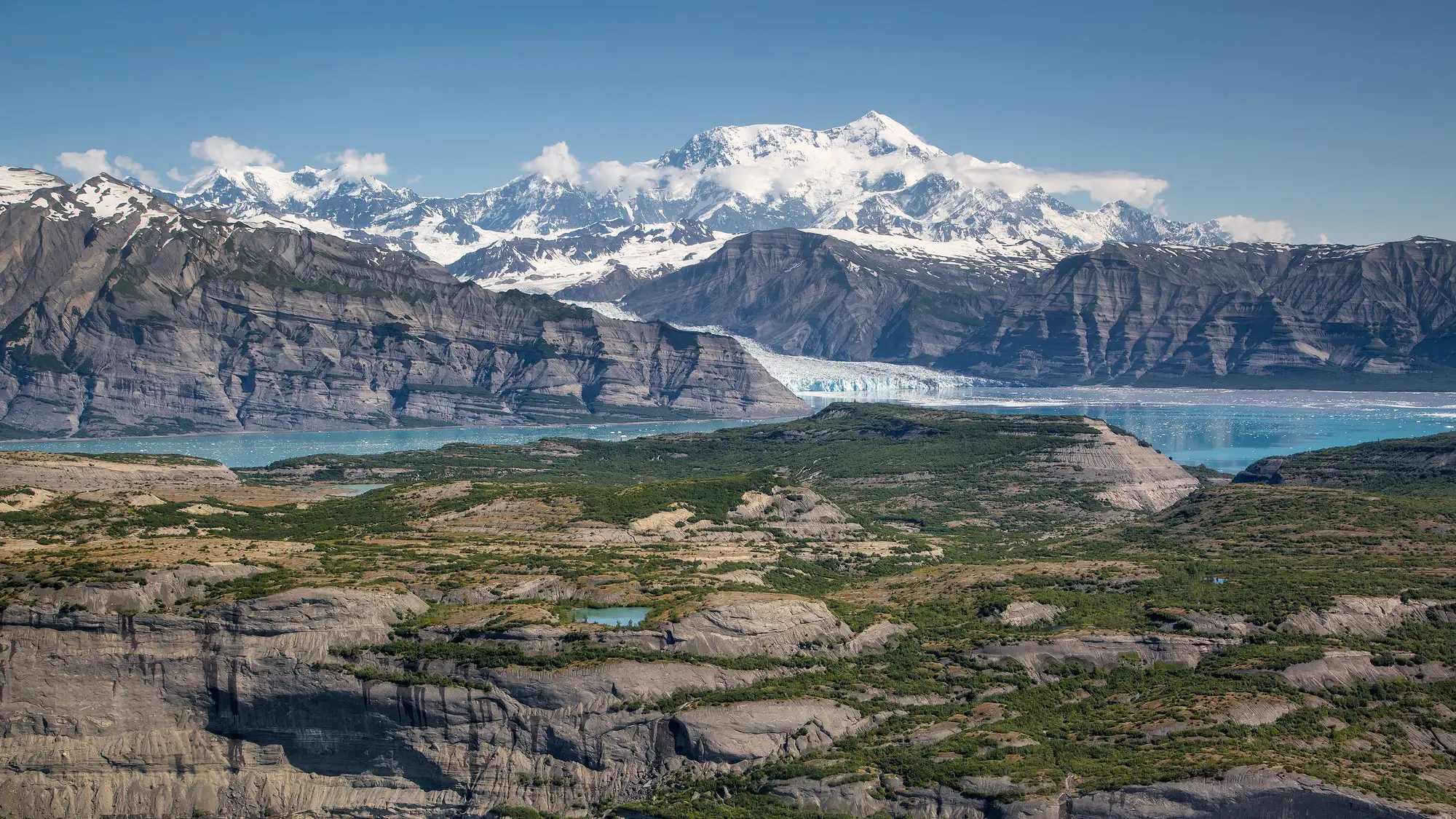
Wrangell-St. Elias covers 13.2 million acres, the same ground as Yellowstone, Yosemite, and Switzerland combined, and it rises from the ocean to 18,008-foot summit country in one continuous sweep of glaciers and peaks. Yet fewer than 80,000 people visit in a year, and nearly all of them stay close to two gravel roads. Step off either one and the scale around you has almost nothing to compete with.
A landscape this large does something specific to a crowded head. When you stand in front of something vast enough that your usual frame of reference gives out, the running inventory of your own worries tends to go quiet. That is not a passing mood so much as a shift in where your attention is pointed.
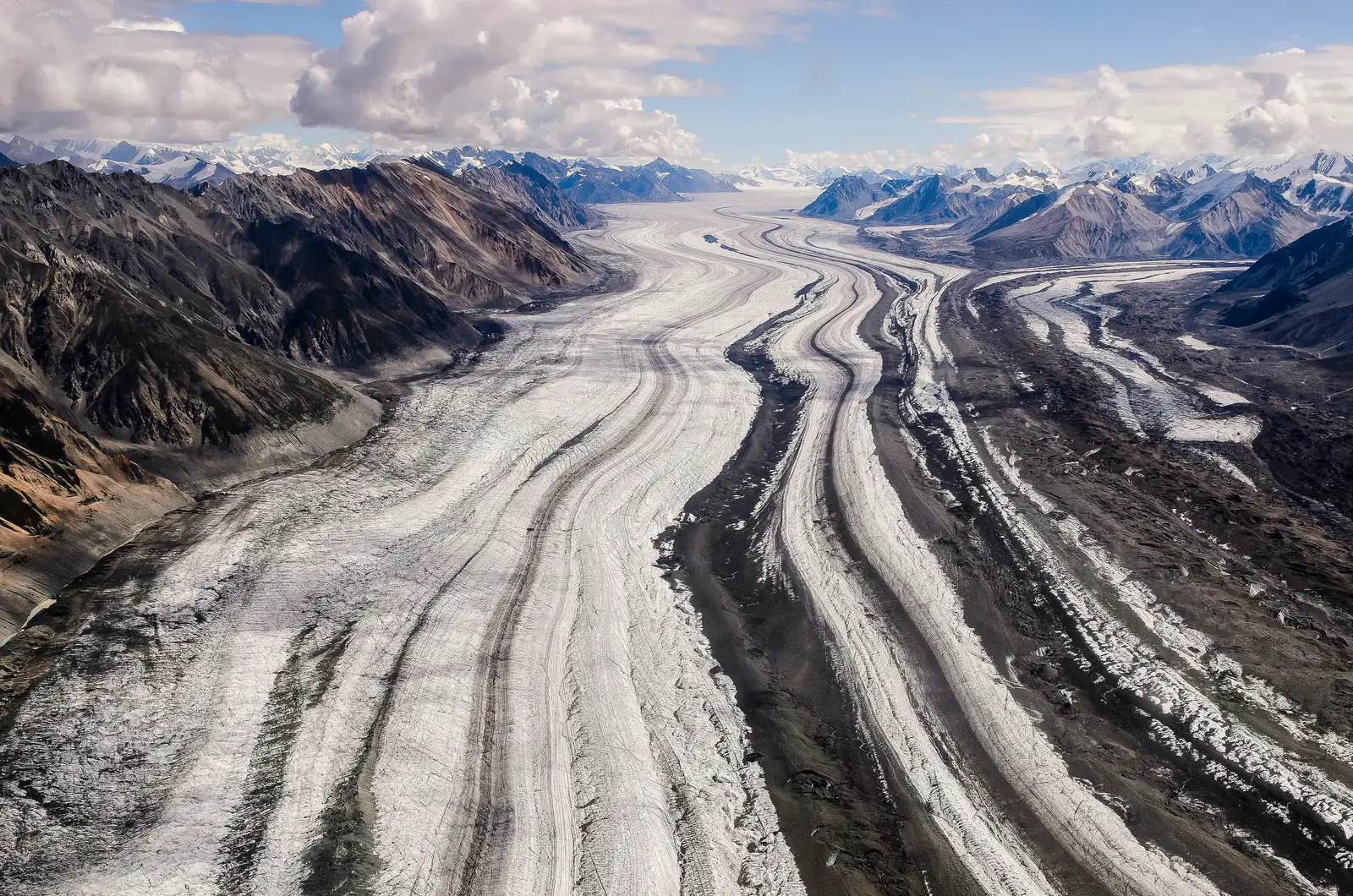
Reaching that feeling here takes no summit and no technical skill. Looking down a glacier from the Root Glacier area, or out across the open valley beyond Nabesna Road, sets you at the edge of something far larger than anything you carried in. The park's emptiness only sharpens the effect.
The science: In a series of studies, Piff and colleagues found that experiences of awe measurably reduced people's self-focus, loosening the grip of self-centered concern. A skyline that runs from tidewater to 18,008 feet, holding glaciers that outlast whole human timelines, is about as dependable a trigger for that shift as any place in the country.
Piff, Dietze, Feinberg, Stancato & Keltner (2015) · Journal of Personality and Social Psychology
Seasonal guide
Crowd levels use NPS monthly visitation, averaged 2015–2025. Excludes 2020 (COVID anomaly) and 2026 (partial year). Temperatures are NOAA climate normals from a station 13 miles away. Busy does not mean bad. If a peak month is your only window, the season notes below tell you how to work it.
April highs reach the upper 40s while May climbs into the low 60s, and the McCarthy and Nabesna roads begin drying out from winter. Snowmelt can leave the gravel soft and some services still shuttered early on, so confirm road and facility status before driving in. Late May brings long daylight and the first steady wave of visitors.
This is peak season and the only stretch with full services, with highs in the upper 60s to low 70s. July and August are also the wettest months at over two inches of rain each, and the gravel access roads stay rough. Crowds cluster around Kennecott and the road pullouts, so a short walk into the backcountry earns near-total solitude.
September cools into the mid-50s and October drops to the upper 30s, bringing fall color and quickly thinning crowds. Visitor facilities begin closing in mid-September, so services shrink fast even while the roads stay open a while longer. Pack layers and plan around early snow and shortening days.
Deep cold and near-total quiet, with January highs around 6F and lows near -9F. Park visitor facilities are closed from mid-September through April, and winter access to Kennecott means covering five miles under your own power on ski or snowshoe. This is aurora and snow-travel season, so come fully self-reliant and check conditions by phone before heading in.
This month in the park
Timing changes everything out here. Pick a month to see when the light turns golden, which nights stay darkest for stargazing, and what visitors have actually recorded in bloom and on the move. The new-moon night is the one to plan a sky-watching evening around.
January 2027
February 2027
March 2027
April 2027
May 2027
Wildlife on the move · 7 species on record
- Trumpeter Swan 1 sightings
- Caribou 1 sightings
- North American Porcupine 1 sightings
- Canadian Tiger Swallowtail 1 sightings
- Boreal Chickadee 1 sightings
June 2027
In bloom · 9 species on record
- ❀ Dwarf Fireweed 2 sightings
- ❀ Fragrant bedstraw 1 sightings
- ❀ Rice root 1 sightings
- ❀ Prickly Saxifrage 1 sightings
- ❀ Pretty Milkvetch 1 sightings
Wildlife on the move · 25 species on record
- Spear-marked and White-banded Black Moths 6 sightings
- Canadian Tiger Swallowtail 5 sightings
- Goldenrod Crab Spider 2 sightings
- Old World Swallowtail 2 sightings
- White-spotted Sawyer 2 sightings
July 2026
In bloom · 15 species on record
- ❀ Tall Bluebell 3 sightings
- ❀ Fireweed 3 sightings
- ❀ Mountain lady's-slipper 2 sightings
- ❀ Small Round-leaved Orchid 2 sightings
- ❀ Dwarf Fireweed 2 sightings
Wildlife on the move · 46 species on record
- White-crowned Sparrow 6 sightings
- Swainson's Thrush 6 sightings
- Red-spotted Admiral 5 sightings
- Dark-eyed Junco 4 sightings
- American Red Squirrel 3 sightings
August 2026
In bloom · 7 species on record
- ❀ Dwarf Fireweed 2 sightings
- ❀ Western columbine 1 sightings
- ❀ Tufted vetch 1 sightings
- ❀ Marsh grass-of-Parnassus 1 sightings
- ❀ Mountain Deathcamas 1 sightings
Wildlife on the move · 51 species on record
- Hoary Comma 7 sightings
- Spruce Grouse 7 sightings
- American Red Squirrel 4 sightings
- Moose 4 sightings
- Merlin 2 sightings
September 2026
Wildlife on the move · 16 species on record
- Pacific Loon 1 sightings
- Red-tailed Hawk 1 sightings
- Bald Eagle 1 sightings
- Savannah Sparrow 1 sightings
- Northern Hawk Owl 1 sightings
October 2026
November 2026
December 2026
Sun and moon times are computed for the park's coordinates from standard NOAA solar equations and cross-checked against the U.S. Naval Observatory. Species lists are research-grade community observations via iNaturalist, retrieved July 2026; sighting counts are all-time records for that calendar month.
Don’t wait for Wrangell - St Elias.
One big trip a year isn’t what changes how you feel — the small stuff in between is. The 7-Day Nature Reset is one tiny outdoor practice a day, wherever you already are. Day one takes 60 seconds.
No spam. No noise. Just nature.
Day 1 is landing in your inbox right now — go say hi.
Sleep nearby
Most visitors base in McCarthy, Alaska, about 1 miles out. McCarthy sits inside the park at the end of the McCarthy Road, the base for Kennecott and the glacier day hikes. Chitina is the last town on pavement; Copper Center near the visitor center is the highway-side alternative. The map opens on McCarthy, so pan toward the park to trade rooms and price for a shorter morning drive.
Camping inside the park books through Recreation.gov and is listed separately.
The map is provided by Stay22. If you book through it we may earn a commission at no cost to you, which helps keep Happier Outdoors running. It never changes what we recommend.
Activities & experiences
Beyond the trails
Along McCarthy Road you can drive, hike, bike, watch wildlife, picnic, and take in the scenic vistas.
Nabesna Road is open for driving, hiking, wildlife watching, picnicking, and scenic views.
Sport fishing here is wide open. Arctic grayling, dolly varden, lake trout, steelhead and rainbow trout, whitefish, and sockeye, coho, and chinook salmon are all widespread, with northern pike, cutthroat trout, and chum and pink salmon in select areas. In winter, local residents fish through the ice for burbot, lake trout, rainbow trout, and whitefish.
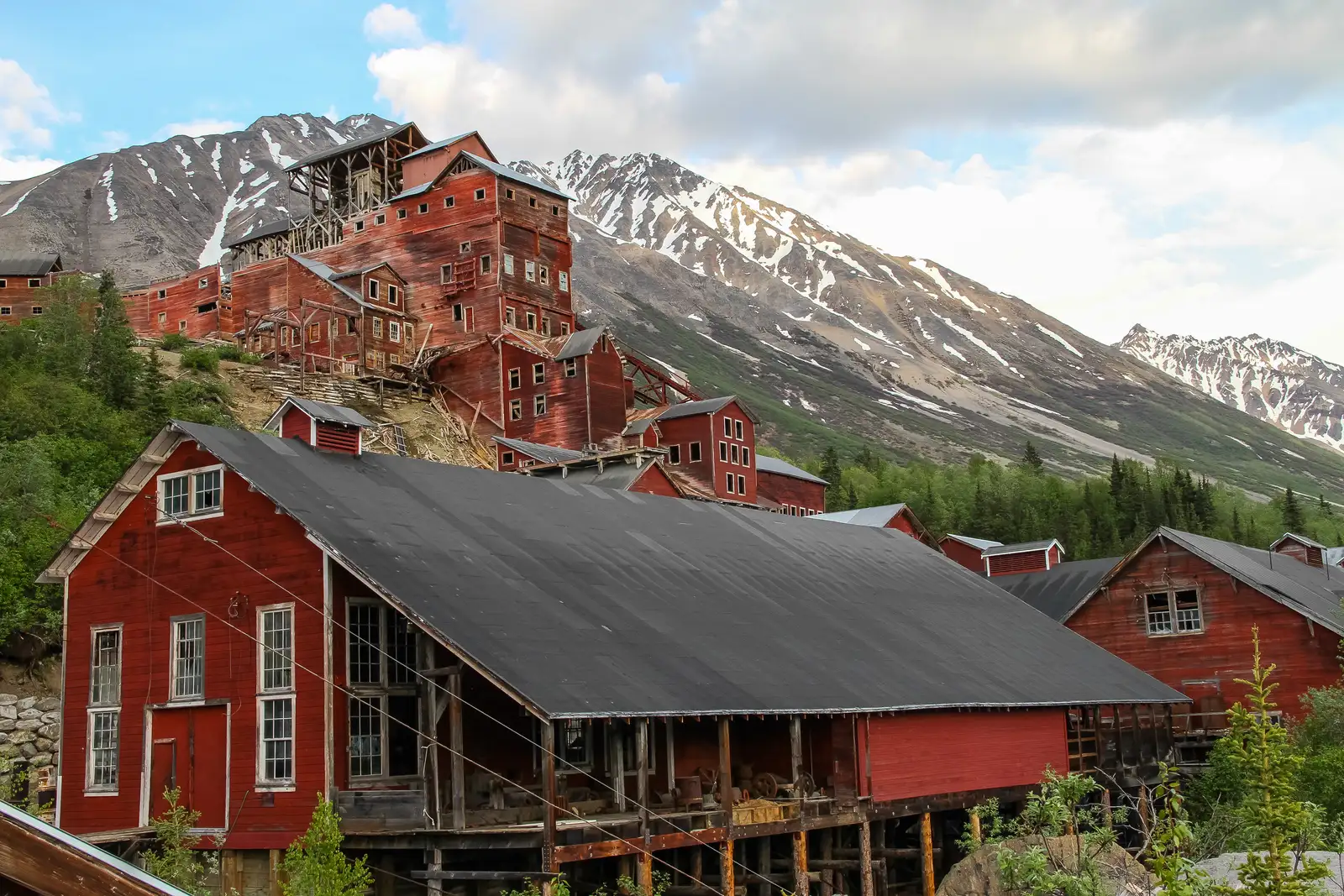
Webcams show the Visitor Center at Park Headquarters in Copper Center, the Kennecott Mill with Mt. Blackburn, and Kennicott Glacier with the Chugach Range.
An interactive virtual tour follows geologists and their helicopter pilot around Kennicott Glacier to show how Park Service staff track changes in its size. A separate Terrestrial LiDAR Scanning Project shares 3-D data used to guide stabilization of the mill structures.
Ghost towns were once thriving communities built on the search for gold, copper, and other valuable minerals, then dwindled over the decades. Some vanished after the boom or were absorbed into newer settlements, but many still stand, a glimpse of people who came to remote country and endured its wildlife, weather, and hardship.
Details and current conditions live on nps.gov.
From the field
Common questions
When is the best time to visit Wrangell-St. Elias?
June through August is the warmest and most accessible window, with highs in the upper 60s to low 70s and visitor facilities open. July is the busiest month, but crowds stay concentrated near Kennecott and the two access roads. Early June or September trade a little warmth for thinner crowds and easier travel.
Is Wrangell-St. Elias dog-friendly?
Yes, leashed dogs are allowed on trails and in the backcountry, including the Root Glacier area and the Boreal Forest Trail. They are not permitted inside visitor centers or on public transportation vehicles. Keep them leashed at all times to avoid wildlife encounters and legal traps set in the area from fall through spring.
What is the quietest trail in Wrangell-St. Elias?
The Nabesna Road trails, such as Nugget Creek and Caribou Creek, are the least crowded in the park. Almost all traffic concentrates on the Root Glacier and historic mine trails near Kennecott, leaving the Nabesna area far quieter. These remote routes require more planning and self-sufficiency.
How crowded does Wrangell-St. Elias get?
It is one of the least-visited national parks, with about 78,000 visitors a year despite being the largest. July peaks at more than 24,000 visits, but crowds cluster along McCarthy Road toward Kennecott and along Nabesna Road, while the vast backcountry stays nearly empty.
Is Wrangell-St. Elias accessible for wheelchairs?
The visitor centers at Copper Center, Kennecott, and Slana are wheelchair accessible, but the park has no paved or wheelchair-accessible trails. Even the popular Root Glacier route is off-trail glacial terrain that requires crampons. Service animals are permitted anywhere visitors can go.
Can you camp at Wrangell-St. Elias?
Yes, though camping here is primitive. The only NPS campground reachable by road is the free, first-come Kendesnii on Nabesna Road, with 10 sites, alongside primitive backcountry sites and public-use cabins. No campgrounds take reservations, but four cabins can be reserved in advance.
Where do you park at Wrangell-St. Elias?
There is no entrance gate or central lot, so you park at ranger stations or trailheads depending on your route. McCarthy Road visitors must park at the Kennicott River Bridge, since no vehicles reach Kennecott itself. Overnight parking is prohibited at public NPS lots, though private fee parking is available near the bridge.
Is there an entrance fee at Wrangell-St. Elias?
No, Wrangell-St. Elias has no entrance fee and no entrance gates. The park and its public lands are free to enter year-round, though visitor facilities operate only in summer.