
Theodore Roosevelt National Park
Medora, North Dakota
Out here, looking is enough
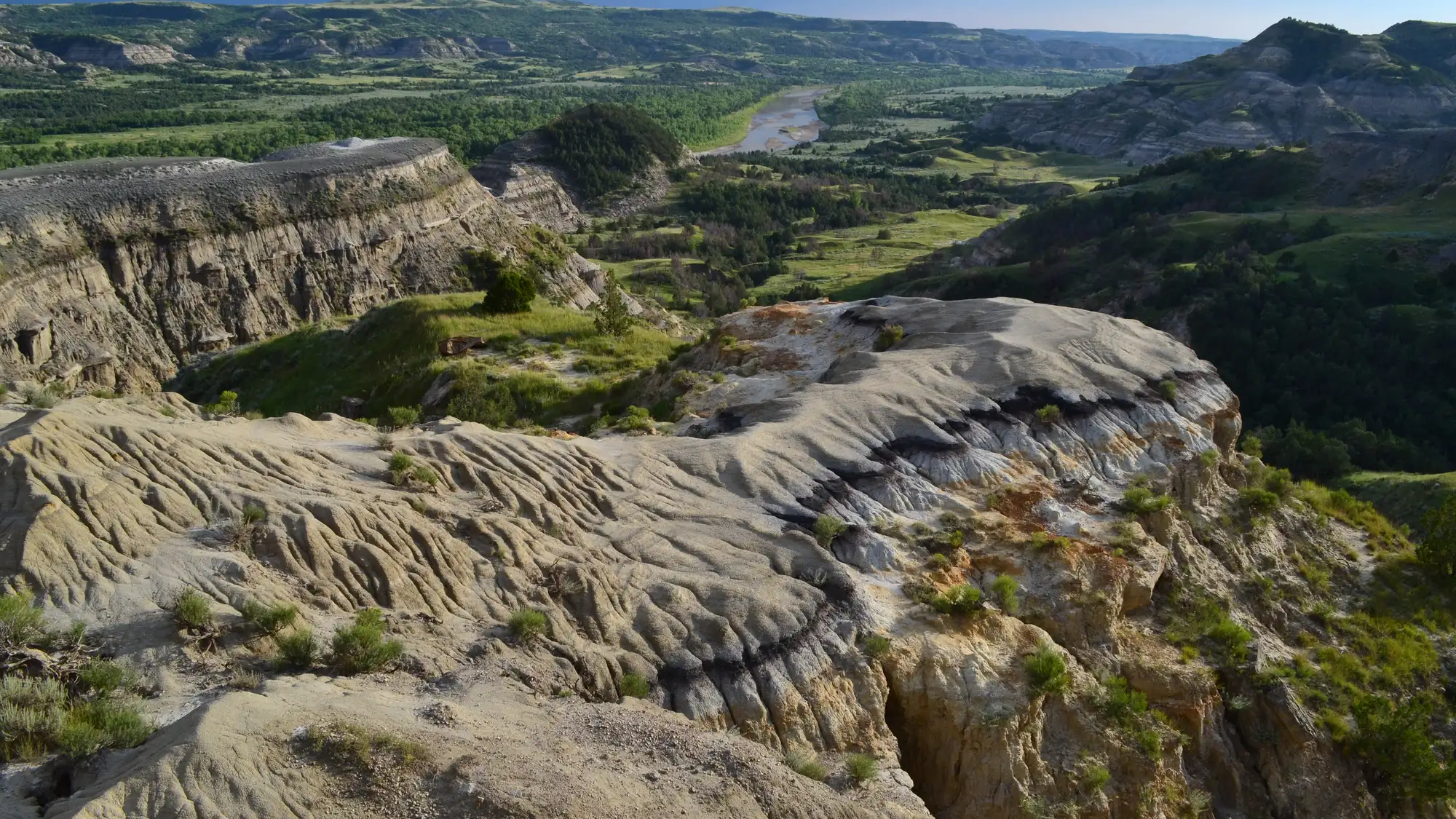
Theodore Roosevelt National Park spreads across three separate units in the North Dakota Badlands, where the Little Missouri River has cut buttes, coulees, and banded rock out of the open prairie. Bison graze the grass, wild horses move along the ridgelines, and prairie dog towns chatter beside the scenic loop roads. Much of a day here is spent watching rather than climbing.
That is not a lesser way to spend it. The overlooks, the slow drive, and the wildlife that wanders into view all invite a kind of attention that costs nothing. You are not scanning for hazards or making decisions, so your eyes just follow the grass, the light on the buttes, a herd working across a flat, and the noise in your head thins out on its own.
The park also stays genuinely quiet once you leave Medora. Hikers report that the remote North Unit, roughly 70 miles north, sees a fraction of the traffic, with trails empty enough that the prairie feels like it belongs to the wildlife.
The science: Environmental psychologist Stephen Kaplan proposed that the sharp, effortful focus we spend all day is a resource that runs down, and that natural scenes restore it because they hold the eye softly instead of demanding it. A visit here is built around that gentler kind of looking: a bison herd crossing a flat, prairie dogs popping up along the loop road, light shifting across the buttes, none of it requiring a choice. Give worn-out attention something like that to rest on and it starts to recover.
Kaplan (1995) · Journal of Environmental Psychology
Seasonal guide
Crowd levels use NPS monthly visitation, averaged 2015–2025. Excludes 2020 (COVID anomaly) and 2026 (partial year). Temperatures are NOAA climate normals from a nearby representative station. Busy does not mean bad. If a peak month is your only window, the season notes below tell you how to work it.
March and April stay quiet and cool, with highs from the mid 40s to mid 50s and cold nights, then May warms into the upper 60s and crowds begin to build. Roads and trails can turn muddy after snowmelt, so check conditions and wear boots that handle sticky clay. It is a strong window for wildlife and open overlooks before the summer rush.
June through August is peak season, with July the single busiest month and highs in the mid 80s. Shade is scarce on the prairie, so carry plenty of water, start early, and use the scenic drives and overlooks during the hottest hours. Wildlife is most active at dawn and dusk when the heat eases.
September and October stay busy but comfortable, with highs falling from the mid 70s to the upper 50s and cool nights, before November drops off sharply in both crowds and temperature. Fall brings golden cottonwoods along the Little Missouri and easier wildlife viewing. Pack layers, since nights approach freezing by October.
December through February are the quietest months by far, with highs in the upper 20s to low 30s and nights often in the single digits. Some or all park roads may close due to snow, so check current conditions before you go and be ready to travel on foot or snowshoes. Those who come find near-total solitude and stark, snow-dusted badlands.
This month in the park
Timing changes everything out here. Pick a month to see when the light turns golden, which nights stay darkest for stargazing, and what visitors have actually recorded in bloom and on the move. The new-moon night is the one to plan a sky-watching evening around.
January 2027
Wildlife on the move · 8 species on record
- American Bison 10 sightings
- Mule Deer 3 sightings
- Sharp-tailed Grouse 2 sightings
- Domestic Horse 2 sightings
- Bighorn Sheep 1 sightings
February 2027
Wildlife on the move · 2 species on record
- American Bison 2 sightings
- North American Porcupine 1 sightings
March 2027
Wildlife on the move · 11 species on record
- American Bison 16 sightings
- Black-tailed Prairie Dog 10 sightings
- Domestic Horse 8 sightings
- Coyote 3 sightings
- Pronghorn 2 sightings
April 2027
In bloom · 6 species on record
- ❀ Prairie pasqueflower 11 sightings
- ❀ Carrotleaf Desert-parsley 1 sightings
- ❀ Spiny phlox 1 sightings
- ❀ Silver buffaloberry 1 sightings
- ❀ Threeleaf Milkvetch 1 sightings
Wildlife on the move · 27 species on record
- American Bison 26 sightings
- Black-tailed Prairie Dog 21 sightings
- Mule Deer 8 sightings
- Domestic Horse 7 sightings
- Wild Turkey 6 sightings
May 2027
In bloom · 29 species on record
- ❀ Prairie pasqueflower 10 sightings
- ❀ Narrowleaf puccoon 6 sightings
- ❀ Textile onion 6 sightings
- ❀ Chokecherry 4 sightings
- ❀ Lambert's Locoweed 4 sightings
Wildlife on the move · 119 species on record
- American Bison 117 sightings
- Black-tailed Prairie Dog 69 sightings
- Domestic Horse 35 sightings
- Lark Sparrow 16 sightings
- Coyote 15 sightings
June 2027
In bloom · 60 species on record
- ❀ Sego Lily 37 sightings
- ❀ Plains Pricklypear 15 sightings
- ❀ Narrow-leaved purple coneflower 14 sightings
- ❀ Scarlet Globemallow 13 sightings
- ❀ Lambert's Locoweed 12 sightings
Wildlife on the move · 213 species on record
- American Bison 197 sightings
- Black-tailed Prairie Dog 133 sightings
- Domestic Horse 65 sightings
- Spotted Towhee 44 sightings
- Lazuli Bunting 40 sightings
July 2026
In bloom · 62 species on record
- ❀ Narrow-leaved purple coneflower 20 sightings
- ❀ Hairy False Goldenaster 7 sightings
- ❀ Field bindweed 6 sightings
- ❀ Purple prairie clover 6 sightings
- ❀ Wild bergamot 6 sightings
Wildlife on the move · 235 species on record
- American Bison 232 sightings
- Black-tailed Prairie Dog 210 sightings
- Domestic Horse 82 sightings
- Leafy Spurge Hawkmoth 38 sightings
- Woodhouse's Toad 33 sightings
August 2026
In bloom · 27 species on record
- ❀ Stiff-leaved goldenrod 13 sightings
- ❀ Dotted gayfeather 10 sightings
- ❀ Curlycup Gumweed 8 sightings
- ❀ Rocky Mountain Beeplant 7 sightings
- ❀ White flat-topped goldenrod 4 sightings
Wildlife on the move · 212 species on record
- American Bison 183 sightings
- Black-tailed Prairie Dog 125 sightings
- Domestic Horse 59 sightings
- Punctured Tiger Beetle 32 sightings
- Big Sand Tiger Beetle 22 sightings
September 2026
In bloom · 11 species on record
- ❀ Hairy False Goldenaster 4 sightings
- ❀ Curlycup Gumweed 2 sightings
- ❀ Stiff-leaved goldenrod 2 sightings
- ❀ Field bindweed 1 sightings
- ❀ Yellow Sweetclover 1 sightings
Wildlife on the move · 158 species on record
- American Bison 106 sightings
- Black-tailed Prairie Dog 94 sightings
- Domestic Horse 39 sightings
- Mule Deer 16 sightings
- Wild Turkey 12 sightings
October 2026
In bloom · 8 species on record
- ❀ Hoary Tansyaster 3 sightings
- ❀ Hairy False Goldenaster 2 sightings
- ❀ Common dandelion 1 sightings
- ❀ Rubber Rabbitbrush 1 sightings
- ❀ Silver buffaloberry 1 sightings
Wildlife on the move · 56 species on record
- American Bison 34 sightings
- Black-tailed Prairie Dog 23 sightings
- Mule Deer 11 sightings
- Domestic Horse 9 sightings
- Coyote 8 sightings
November 2026
Wildlife on the move · 24 species on record
- American Bison 23 sightings
- Mule Deer 13 sightings
- Wild Turkey 11 sightings
- Black-tailed Prairie Dog 10 sightings
- Bighorn Sheep 8 sightings
December 2026
Wildlife on the move · 18 species on record
- American Bison 11 sightings
- Mule Deer 7 sightings
- Black-tailed Prairie Dog 5 sightings
- Wild Turkey 4 sightings
- Black-billed Magpie 4 sightings
Sun and moon times are computed for the park's coordinates from standard NOAA solar equations and cross-checked against the U.S. Naval Observatory. Species lists are research-grade community observations for Theodore Roosevelt National Park, US, ND via iNaturalist, retrieved July 2026; sighting counts are all-time records for that calendar month.
Don’t wait for Theodore Roosevelt.
One big trip a year isn’t what changes how you feel — the small stuff in between is. The 7-Day Nature Reset is one tiny outdoor practice a day, wherever you already are. Day one takes 60 seconds.
No spam. No noise. Just nature.
Day 1 is landing in your inbox right now — go say hi.
Sleep nearby
Places to stay around Medora, North Dakota. Pan the map to trade a shorter drive for a quieter night.
Camping inside the park books through Recreation.gov and is listed separately.
The map is provided by Stay22. If you book through it we may earn a commission at no cost to you, which helps keep Happier Outdoors running. It never changes what we recommend.
Let someone else lead
A guide is worth it when the terrain needs one, or when you would rather look around than navigate. These are the highest-rated trips running around Theodore Roosevelt, not the cheapest.
 Free cancellation
 Chasing Horses Back to Nature Experience in North Dakota
- Runs year-round
- Private tour, up to 4
- Easy for most fitness levels
 Free cancellation
 Self Guided Audio Tour of Theodore Roosevelt National Park
- Runs year-round
- Easy for most fitness levels
 Free cancellation
 Theodore Roosevelt National Park Self-Guided Driving Audio Tour
- Easy for most fitness levels
Tours are listed by Viator; booking happens there. If you book we may earn a commission at no cost to you, which helps keep Happier Outdoors running. It never changes what we list. Prices checked September 2026 and can change.
Activities & experiences
Beyond the trails
The night skies here are dark and clear, good for stargazing whether you know the constellations or not. It works year round.
The South Unit is home to a wide variety of wildlife. Take your time and see what you can find.
Head into the North Unit to look for the many animals that live there.
The North Dakota badlands host more than 180 species of birds. See how many you can spot.
The scenic drive is your way into the South Unit. It opens up the landscape without much effort.
This scenic drive leads into the rougher, more rugged North Unit.
Details and current conditions live on nps.gov.
From the field
Common questions
When is the best time to visit Theodore Roosevelt National Park?
Late spring and early fall offer the most comfortable weather with far smaller crowds than midsummer. May highs reach the upper 60s and September the mid 70s, while July and August, the busiest months, climb into the mid 80s. Winter is quietest but roads may close with snow.
Is Theodore Roosevelt National Park dog-friendly?
Yes, leashed dogs are welcome in developed areas but not on any park trails or in the backcountry. They are allowed on roads and shoulders within six feet of the edge, in campgrounds and picnic areas, and on the Painted Canyon Visitor Center sidewalk, and must be kept leashed to six feet and well away from bison and wild horses.
What is the quietest trail in Theodore Roosevelt National Park?
Hikers consistently point to the North Unit's trails, such as the Caprock Coulee Loop, as the quietest in the park. Most visitors stay in the South Unit near Medora and only drive the scenic loop, so the North Unit, about 70 miles away, is often nearly deserted.
How crowded does Theodore Roosevelt National Park get?
The park is busiest in June, July, and August, with July drawing the most visitors of any month. It receives close to 600,000 people a year with no timed entry, and crowds concentrate at popular overlooks, trailheads, and campgrounds from roughly mid-morning to late afternoon.
Is Theodore Roosevelt National Park accessible for wheelchairs?
All three visitor centers and the Maltese Cross Cabin are wheelchair accessible, along with several paved overlooks and pullouts. The park runs no shuttles, so access relies on personal vehicles; Cottonwood Campground has four accessible sites and Juniper has two, while most trails are unmaintained dirt.
Can you camp at Theodore Roosevelt National Park?
Yes, the park has two main campgrounds, Cottonwood in the South Unit and Juniper in the North Unit, both reservable through recreation.gov. Sites are primitive with no hookups or showers, and individual sites can be booked up to six months in advance.
How much does it cost to enter Theodore Roosevelt National Park?
A private vehicle pass costs $30 and is valid for seven days across all three units. Motorcycles are $25, individuals on foot or bike pay $15, and an annual park pass is $55.