
Lake Clark National Park & Preserve
Port Alsworth, Alaska · Alaska
The lakes do quiet work
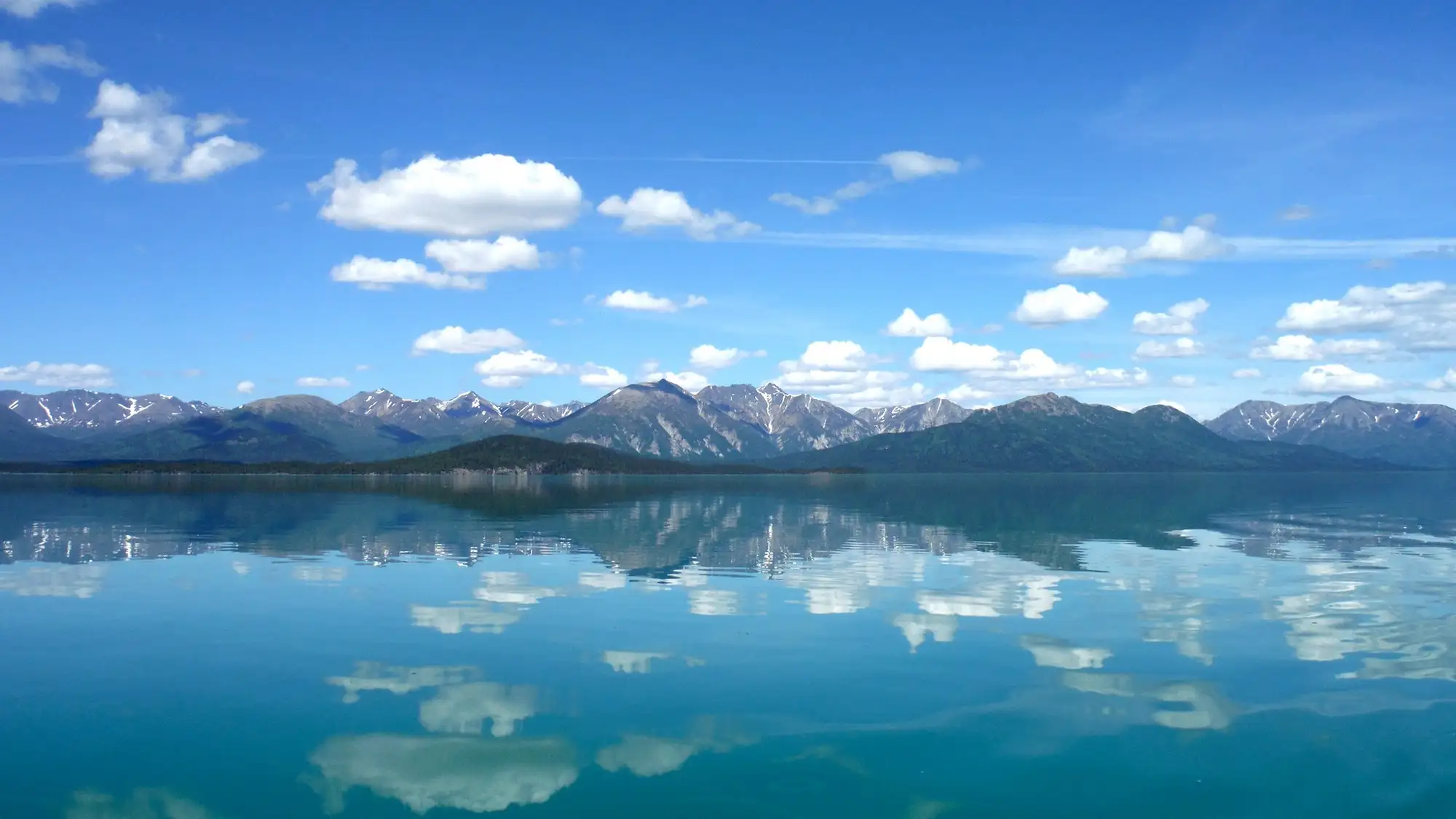
Lake Clark is stitched together by water. Meltwater lakes hold a turquoise color that comes from glacial silt, and on a still morning the craggy peaks sit mirrored on the surface. Salmon push up the rivers, bears work the tidal flats along the coast, and two volcanoes steam over all of it. There is no road in, so nearly everyone arrives by small plane onto a lake, a gravel bar, or a beach.
Water is the constant, whether you are watching Upper Twin Lake from the shore or standing on the coast at Silver Salmon Creek. That matters for the head you brought with you. A wide sheet of water gives your eyes a low, undemanding place to rest, and the sound of a river or a lapping shore carries none of the intrusive edge that traffic and notifications do.
Reaching it takes effort, and that effort works in your favor. By the time a plane sets down on a lake, phones have gone silent and the errands you flew in with have no way to reach you. What is left is water, wind, and the occasional splash of a salmon, which is about as little as a busy mind is ever asked to hold.
The science: Population research by White and colleagues found that contact with blue space, meaning coasts, rivers, and lakes, is associated with better mental health, and it showed up at the scale of whole populations rather than only among people who go out of their way to seek water. At Lake Clark, water is unavoidable: turquoise lakes reflecting the peaks, salmon rivers, and the tidal coast at Silver Salmon Creek are the throughline of almost any visit, so the calming pull of it is not reserved for hardcore adventurers who fly in.
White, Elliott, Gascon, Roberts & Fleming (2021) · Environmental Research
Seasonal guide
Crowd levels use NPS monthly visitation, averaged 2015–2025. Excludes 2020 (COVID anomaly). Temperatures are NOAA climate normals from a nearby representative station. Busy does not mean bad. If a peak month is your only window, the season notes below tell you how to work it.
Deep cold and near-total quiet define December through February, with highs in the low to high 20s and lows near or below zero. Lakes freeze from November, so bush planes land on skis rather than floats and visitor services are minimal. Come for aurora and snow travel, book a flight with an operator equipped for winter, and pack for real Alaska cold.
Spring stays quiet through March and April and picks up in May, with highs climbing from the low 30s to the upper 50s. Ice on the lakes doesn't clear until April and frost and snow remain common, so this is a transitional window for landings. Confirm whether your plane needs skis or floats and expect changeable conditions.
Summer is the peak season and the heart of bear viewing, with July and August drawing about 70% of the year's visitors. Highs run in the low to mid-60s and August is the wettest month, so pack rain gear. Book air taxis and lodges well ahead, and aim for early morning or late evening at coastal flats like Chinitna Bay when bears are most active.
Visitation drops off through fall, busy in September and quiet by November, as highs slide from the mid-50s toward freezing nights and snow. September is among the wettest months, and weather can ground flights as the season turns. Fall rewards flexible travelers with color and returning quiet, so build in buffer days for your return flight.
This month in the park
Timing changes everything out here. Pick a month to see when the light turns golden, which nights stay darkest for stargazing, and what visitors have actually recorded in bloom and on the move. The new-moon night is the one to plan a sky-watching evening around.
January 2027
February 2027
March 2027
April 2027
May 2027
June 2027
Wildlife on the move · 2 species on record
- Brown Bear 4 sightings
- Moose 1 sightings
July 2026
In bloom · 2 species on record
- ❀ Richardson's Brookfoam 1 sightings
- ❀ Dwarf Fireweed 1 sightings
Wildlife on the move · 24 species on record
- Spiny Leaf Gall Wasp 7 sightings
- American Black Bear 3 sightings
- Thinhorn Sheep 2 sightings
- Fuzzy-Horned Bumble Bee 2 sightings
- Moose 2 sightings
August 2026
In bloom · 3 species on record
- ❀ Marsh grass-of-Parnassus 3 sightings
- ❀ Partridgefoot 1 sightings
- ❀ Fireweed 1 sightings
Wildlife on the move · 5 species on record
- Brown Bear 3 sightings
- Gray Wolf 1 sightings
- Old World Swallowtail 1 sightings
- Black-billed Magpie 1 sightings
- Dasineura epilobii 1 sightings
September 2026
Wildlife on the move · 2 species on record
- Dark-eyed Junco 1 sightings
- Ross' Tussock Moth 1 sightings
October 2026
November 2026
December 2026
Sun and moon times are computed for the park's coordinates from standard NOAA solar equations and cross-checked against the U.S. Naval Observatory. Species lists are research-grade community observations via iNaturalist, retrieved July 2026; sighting counts are all-time records for that calendar month.
Don’t wait for Lake Clark.
One big trip a year isn’t what changes how you feel — the small stuff in between is. The 7-Day Nature Reset is one tiny outdoor practice a day, wherever you already are. Day one takes 60 seconds.
No spam. No noise. Just nature.
Day 1 is landing in your inbox right now — go say hi.
Sleep nearby
Most visitors base in Anchorage, Alaska, about 0 miles out. Anchorage is the nearest major city with far more rooms and better prices, though the park has no road access so all travel is by air taxi or boat. Port Alsworth sits on the park's eastern shore but is reachable only by air taxi or boat with very limited lodging. The map opens on Anchorage, so pan toward the park to trade rooms and price for a shorter morning drive.
Camping inside the park books through Recreation.gov and is listed separately.
The map is provided by Stay22. If you book through it we may earn a commission at no cost to you, which helps keep Happier Outdoors running. It never changes what we recommend.
Activities & experiences
Beyond the trails
Reach the West Cook Inlet coast by plane to watch bears. First learn where to go and the bear viewing best practices. Then watch the park's new 11 minute film, A Day on the Lake Clark National Park Coastline, for a feel of what the coast is like.
Paddling out to Tommy Island is a good way to meet Lake Clark up close. Launch from Port Alsworth and spend a day on the water, watching birds and jumping fish.
Some of the most pristine fishery habitats in the National Park system sit within Lake Clark. Fly or boat out from Port Alsworth and cast into the lake.
New to fishing in Alaska? Tanalian Falls is a scenic spot with a chance at grayling and plenty to photograph.
From the air you can take in volcanoes, coastline, mountain ranges, tundra, lakes, rivers, and wildlife. A flight is a safe way to see the scale of the place.
Camping into the trail-less backcountry brings undeveloped wilderness, self-reliance, and solitude that is hard to find elsewhere. It can be spectacular, but thorough preparation and careful planning matter for a safe trip.
Details and current conditions live on nps.gov.
From the field
Common questions
When is the best time to visit Lake Clark?
July and August are the best window, offering the mildest weather and the peak of bear viewing, though they are also the busiest months. Summer highs run in the low to mid-60s, with August being the wettest month, so plan for rain and book air taxis and lodges well ahead.
Is Lake Clark dog-friendly?
Leashed pets are allowed throughout Lake Clark, but the Park Service strongly encourages leaving them home because of the high risk of bear and moose encounters. Leashes must be no longer than six feet, pets can't be left unattended, and their waste must be buried in a cathole or packed out.
What is the quietest trail at Lake Clark?
The Beaver Pond Trail, a 3.2-mile round trip through birch groves near Port Alsworth, is the quietest maintained trail because it steers away from the main waterfall attraction. The Kontrashibuna Lake Trail is also very secluded, since most day hikers stop at Tanalian Falls rather than continuing past it into the wilderness.
How crowded does Lake Clark get?
Lake Clark is one of the least-visited national parks even by Alaska standards, drawing well under 20,000 visitor-use days a year. July and August account for roughly 70% of that traffic, and it concentrates at Chinitna Bay, Crescent Lake, and Silver Salmon Creek, so the rest of the park stays genuinely empty.
Is Lake Clark accessible for wheelchairs and strollers?
Accessibility is minimal, as the park is a roadless, largely trailless wilderness with no paved or wheelchair-accessible trails. Most NPS buildings, visitor services, and charter operations lack disability access, and reaching the park requires travel by float plane, wheeled plane, or boat.
Can you camp at Lake Clark?
Yes, though there are no developed campgrounds; camping is primitive and you may generally camp where you like in the trail-free wilderness. The Hope Creek area on Upper Twin Lake is the one named primitive site, and it is first-come, first-served with no fee and no services.
Is there an entrance fee for Lake Clark?
No, there is no entrance fee for Lake Clark National Park & Preserve. The park is open 24 hours a day, year-round, though visitor services are limited from Labor Day through Memorial Day.
Where do you park at Lake Clark?
There is no parking at Lake Clark because it is not on the road system. Access is only by plane or boat, with a one-to-two-hour flight from Anchorage, Kenai, or Homer reaching most points in the park.