Kenai Fjords National Park
Seward, Alaska · Alaska
Ice older than anything you brought
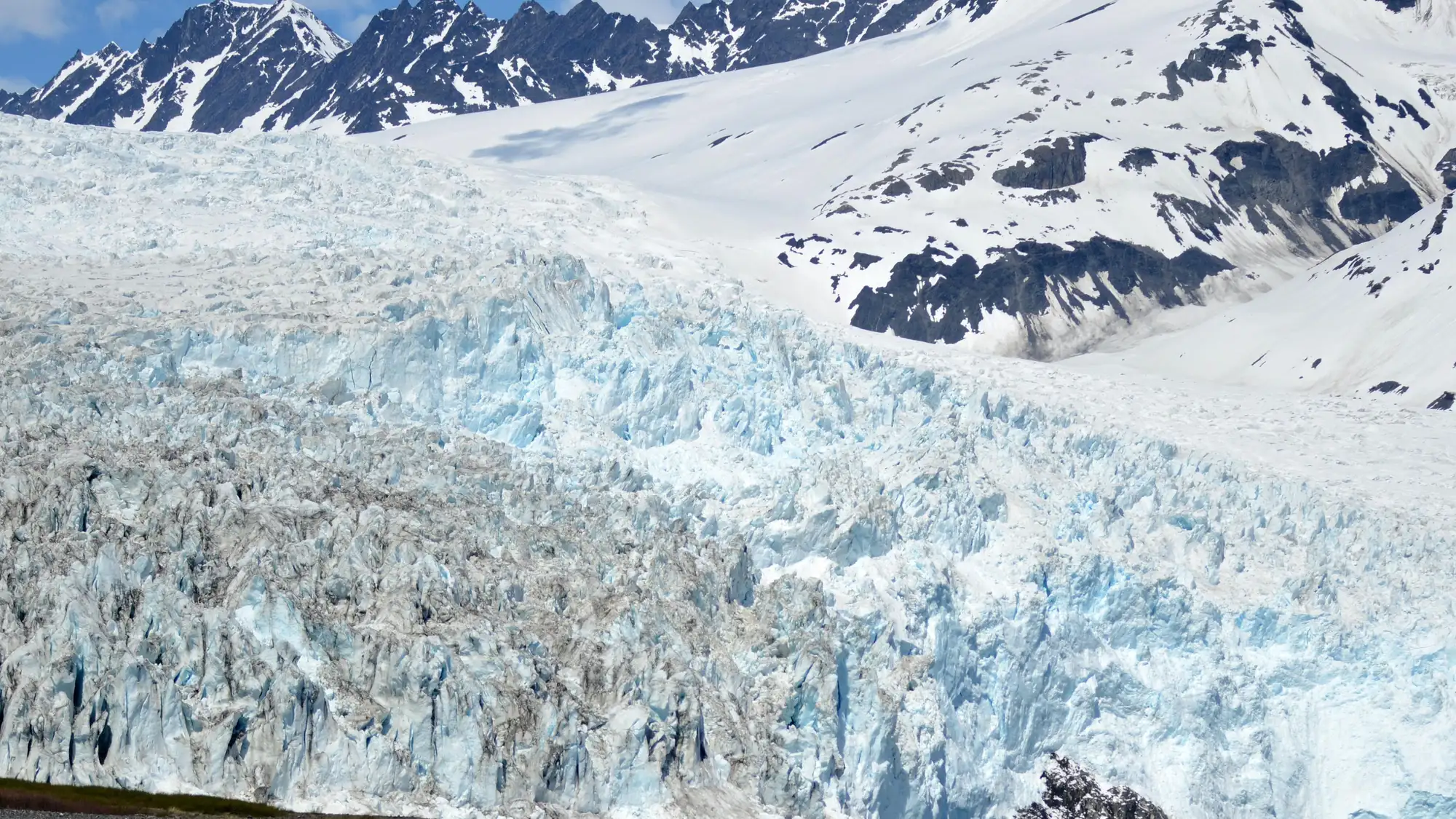
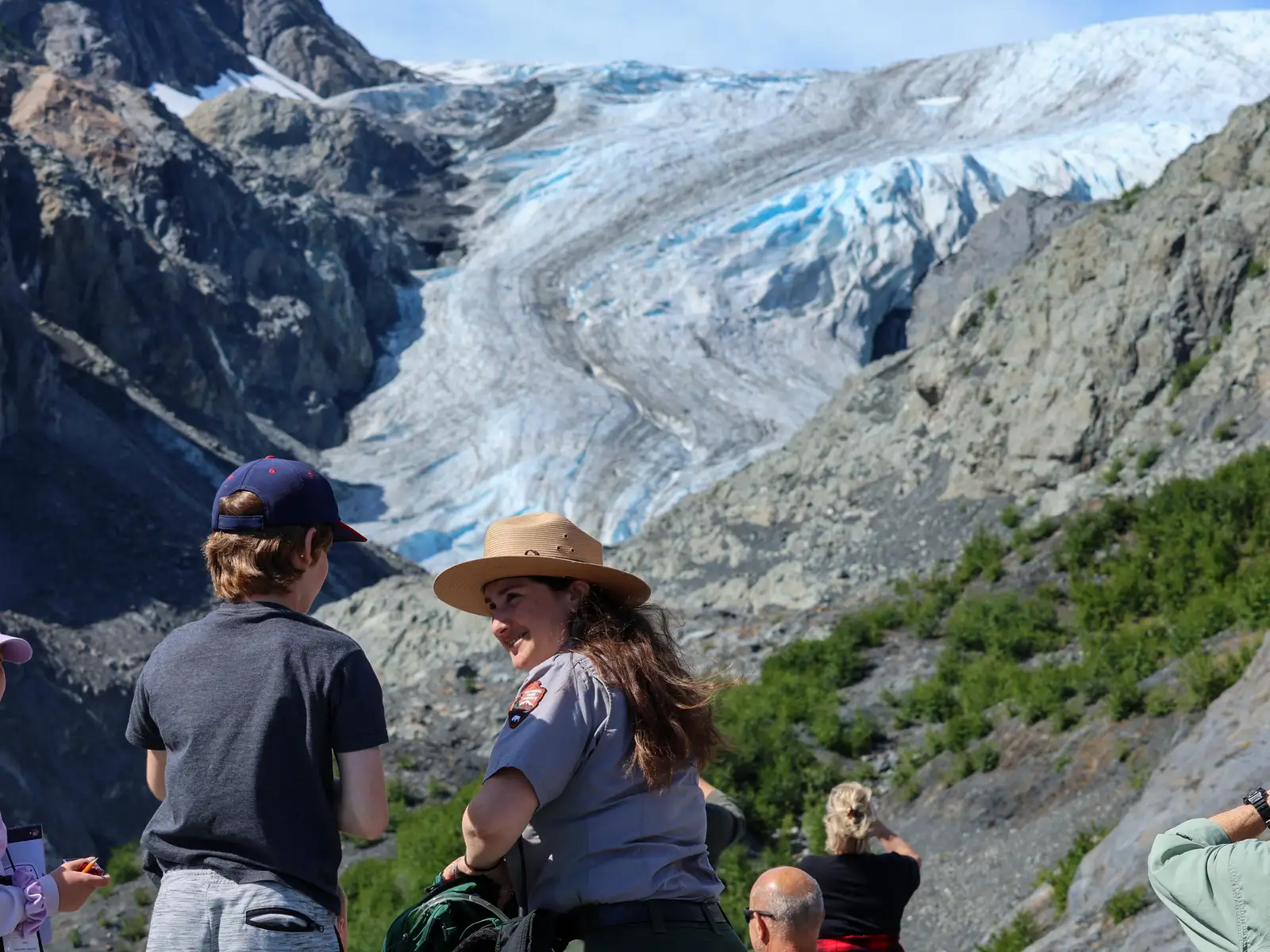
Kenai Fjords is what the last ice age left behind, still in motion. The Harding Icefield spreads across the top of the park and feeds nearly 40 glaciers, some of them grinding all the way down to tidewater, where they calve into the fjords the ice once carved. Set a person against that and the scale turns almost comic. You are looking at something older and larger than anything you drove in with.
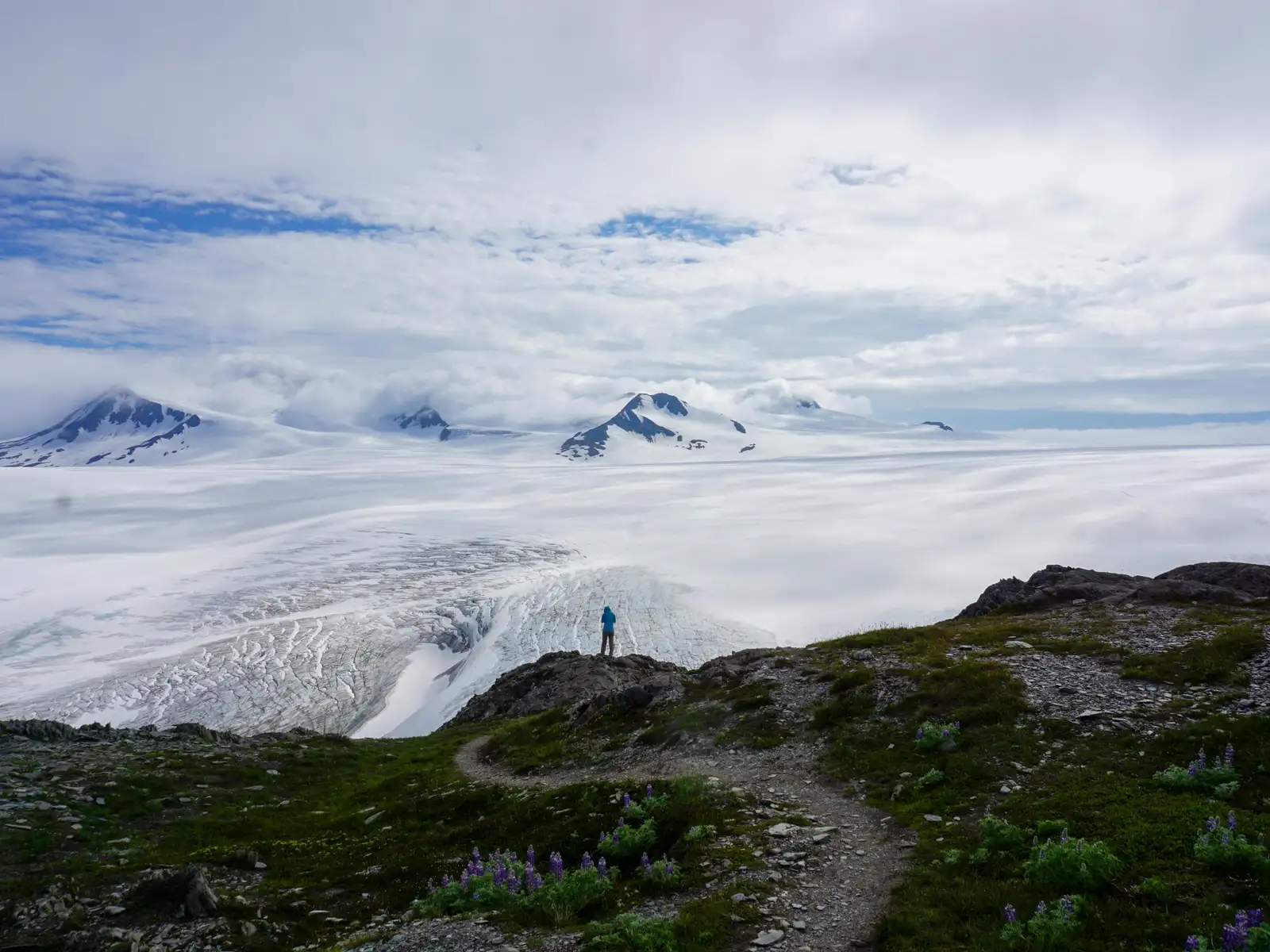
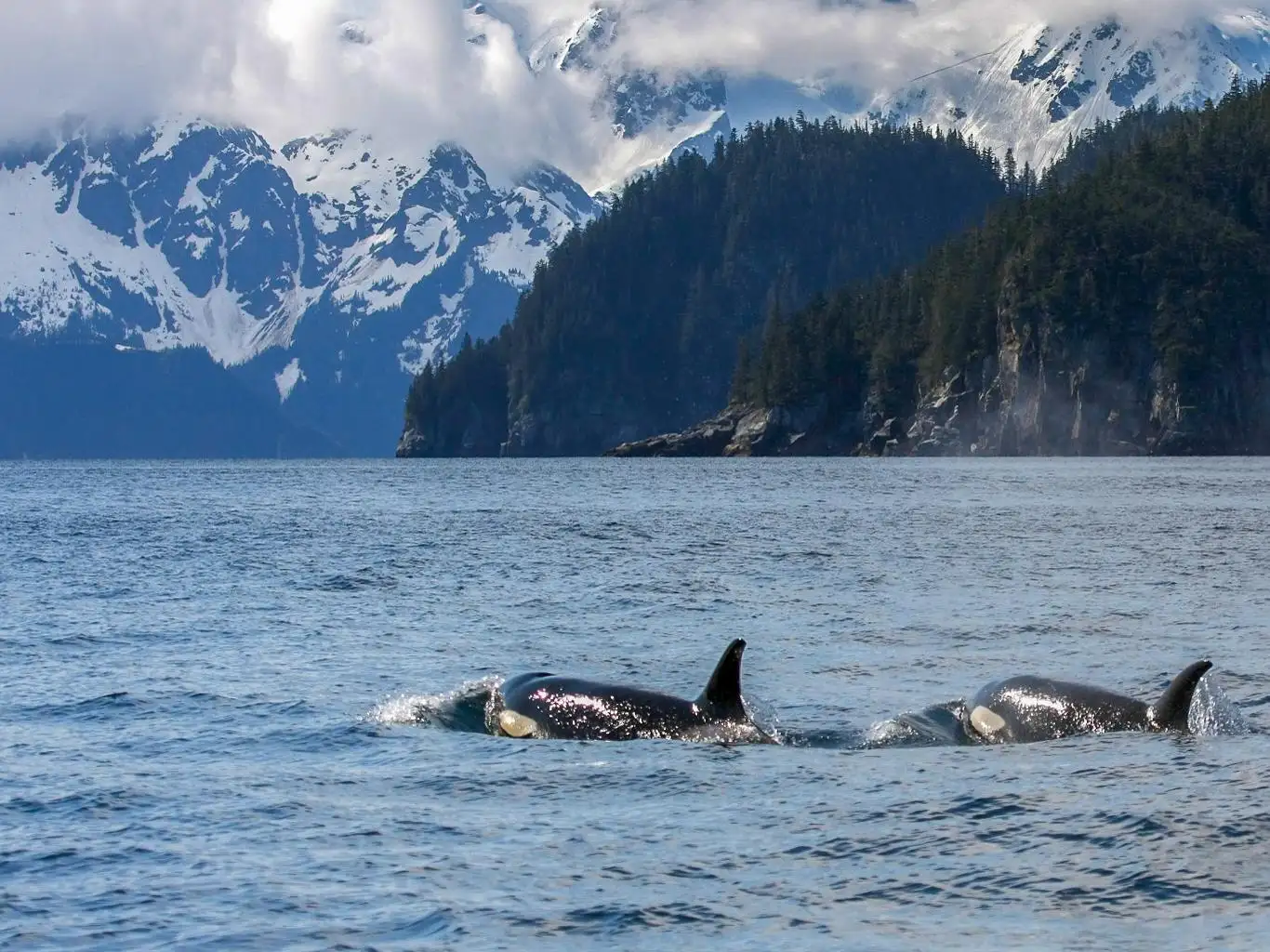
Most people meet the ice one of two ways. A boat tour runs out through the fjords past sea otters, seabirds, and whales to a glacier face that drops slabs of ice into the water while you watch. On land, the trail toward the edge of the Harding Icefield climbs until the forest ends and an unbroken sheet of white opens in every direction.
That sense of being small in front of something vast is not just a nice view. It pulls attention off your own running worries, which is a good part of why a glacier does something a photo of one never will.
The science: In a series of studies, the psychologist Paul Piff and colleagues found that moments of awe pulled people's focus off themselves and left them measurably more generous. Their framing treats awe as something reliably triggered, not rare, produced on demand by the right scene rather than waiting on a lucky moment. At Kenai Fjords a glacier shearing ice into the sea supplies exactly that kind of dependable trigger, and most fjord boat tours are built around watching it happen.
Piff, Dietze, Feinberg, Stancato & Keltner (2015) · Journal of Personality and Social Psychology
Seasonal guide
Crowd levels use NPS monthly visitation, averaged 2015–2025. Excludes 2020 (COVID anomaly) and 2026 (partial year). Temperatures are NOAA climate normals from a nearby representative station. Busy does not mean bad. If a peak month is your only window, the season notes below tell you how to work it.
December through February is the quietest stretch, with only a trickle of visitors. Highs sit in the low 30s and lows in the low 20s, cold snaps can reach 20 below, and the road to Exit Glacier goes unplowed and closes once snow and ice cover it. Seward stays reachable year-round on the Seward Highway, making this the window for skiing, snowshoeing, or booking the Willow winter cabin.
March and April stay very quiet before visitation jumps in May as the season opens. Highs climb from the upper 30s into the low 50s, with lows near freezing early on, and May brings reduced services alongside the first tour boats. Come now for smaller crowds, but confirm what is actually operating before you rely on it.
June through August is peak, drawing over 180,000 people to the Exit Glacier area alone. Highs run from the upper 50s to low 60s with regular cool rain, and parking fills between roughly 10:30 a.m. and 3:30 p.m., so arrive early or take a shuttle from Seward. This is also when boat tours and ranger programs run at full strength.
September stays busy and October tapers off fast before November empties out. This is the wettest stretch, with September averaging nearly 10 inches of rain and highs sliding from the mid 50s toward freezing by November. Services wind down after September, so plan around a shorter list of what is open.
This month in the park
Timing changes everything out here. Pick a month to see when the light turns golden, which nights stay darkest for stargazing, and what visitors have actually recorded in bloom and on the move. The new-moon night is the one to plan a sky-watching evening around.
January 2027
February 2027
March 2027
April 2027
May 2027
Wildlife on the move · 26 species on record
- Moose 8 sightings
- Steller's Jay 4 sightings
- Hermit Thrush 4 sightings
- Brown Bear 4 sightings
- American Black Bear 3 sightings
June 2027
In bloom · 20 species on record
- ❀ Western columbine 6 sightings
- ❀ Rice root 4 sightings
- ❀ Arctic Butterbur 3 sightings
- ❀ Salmonberry 2 sightings
- ❀ Fringe cups 2 sightings
Wildlife on the move · 68 species on record
- American Black Bear 19 sightings
- Mountain Goat 18 sightings
- Hermit Thrush 16 sightings
- Moose 11 sightings
- Fox Sparrow 10 sightings
July 2026
In bloom · 46 species on record
- ❀ Western columbine 31 sightings
- ❀ Dwarf Fireweed 14 sightings
- ❀ Rice root 11 sightings
- ❀ Bog wintergreen 9 sightings
- ❀ Broad-petal Gentian 8 sightings
Wildlife on the move · 93 species on record
- Hoary Marmot 32 sightings
- American Black Bear 15 sightings
- Mountain Goat 14 sightings
- Moose 9 sightings
- Varied Thrush 8 sightings
August 2026
In bloom · 10 species on record
- ❀ Dwarf Fireweed 5 sightings
- ❀ Fireweed 4 sightings
- ❀ Partridgefoot 3 sightings
- ❀ Rice root 2 sightings
- ❀ Woolly cranesbill 1 sightings
Wildlife on the move · 66 species on record
- Common Murre 16 sightings
- Hoary Marmot 13 sightings
- Horned Puffin 12 sightings
- Mountain Goat 12 sightings
- Black-legged Kittiwake 11 sightings
September 2026
In bloom · 3 species on record
- ❀ Broad-petal Gentian 2 sightings
- ❀ Partridgefoot 1 sightings
- ❀ Fireweed 1 sightings
Wildlife on the move · 26 species on record
- Hoary Marmot 10 sightings
- Mountain Goat 5 sightings
- Moose 4 sightings
- Bald Eagle 3 sightings
- American Black Bear 3 sightings
October 2026
Wildlife on the move · 3 species on record
- Mountain Goat 3 sightings
- Willow Ptarmigan 1 sightings
- Steller's Jay 1 sightings
November 2026
December 2026
Sun and moon times are computed for the park's coordinates from standard NOAA solar equations and cross-checked against the U.S. Naval Observatory. Species lists are research-grade community observations for Kenai Fjords National Park, US, AK via iNaturalist, retrieved July 2026; sighting counts are all-time records for that calendar month.
Don’t wait for Kenai Fjords.
One big trip a year isn’t what changes how you feel — the small stuff in between is. The 7-Day Nature Reset is one tiny outdoor practice a day, wherever you already are. Day one takes 60 seconds.
No spam. No noise. Just nature.
Day 1 is landing in your inbox right now — go say hi.
Sleep nearby
Places to stay around Seward, Alaska. Pan the map to trade a shorter drive for a quieter night.
Camping inside the park books through Recreation.gov and is listed separately.
The map is provided by Stay22. If you book through it we may earn a commission at no cost to you, which helps keep Happier Outdoors running. It never changes what we recommend.
Let someone else lead
A guide is worth it when the terrain needs one, or when you would rather look around than navigate. These are the highest-rated trips running around Kenai Fjords, not the cheapest.

Exit Glacier Nature Hike
- Runs May–Sep
- Up to 10 per booking
- Service animals welcome
 Free cancellation
 Kenai Fjords and Resurrection Bay Half-Day Wildlife Cruise
- Runs Jun–Oct
- Service animals welcome
 Free cancellation
 Resurrection Bay Spring Wildlife Cruise
- Up to 15 per booking
- Wheelchair accessible

Seward and Kenai Fjords National Park Guided Tour with Lunch
- Runs May–Sep
- Up to 15 per booking
- Stroller accessible
Tours are listed by Viator; booking happens there. If you book we may earn a commission at no cost to you, which helps keep Happier Outdoors running. It never changes what we list. Prices checked September 2026 and can change.
Activities & experiences
Beyond the trails
Take a kayak into the waters of Kenai Fjords. Every paddle stroke connects you to a long history of human powered travel along the Kenai Peninsula coast.
Boat tours leave Seward's small boat harbor daily through the summer. They carry you deeper into the park than you could reach on your own.
Winter changes the way you move here. Once the road to Exit Glacier is snow-covered and closed to cars, you can reach it by fat bike or cross-country skis.
The area around Kenai Fjords offers strong fishing, both freshwater and salt water.
Walk with a ranger and learn how these fjord ecosystems work. Kids can earn a Fjord Junior Ranger designation along the way.
Check out a Discovery Backpack or an Art for Parks backpack, complete the activities, and earn a Glacier Junior Ranger patch.
Details and current conditions live on nps.gov.
From the field
Common questions
When is the best time to visit Kenai Fjords National Park?
The main season runs June through August, when the road to Exit Glacier is open and boat tours run daily. Summer highs sit in the mid 40s to low 70s with frequent cool, rainy, overcast days, so bring layers and rain gear. May and September have reduced services but far smaller crowds.
Is Kenai Fjords National Park dog-friendly?
Pets are not allowed on any trails in the park, but leashed pets are permitted on the road to Exit Glacier and in the Exit Glacier parking lot. They are also prohibited in campsites, buildings, and the coastal backcountry, and service animals are the only exception. Keep pets leashed to six feet and never leave them unattended.
What is the quietest trail in Kenai Fjords National Park?
There is no quiet, less-crowded trail, because the park has only two maintained trails and both sit at the single road-accessible Exit Glacier area. About 99% of the park is roadless wilderness, so the real solitude comes from reaching the remote fjords and glaciers by boat or plane rather than from a lesser trail.
How crowded does Kenai Fjords National Park get?
The park drew roughly 389,000 visitors in 2023 and 419,000 in 2024, with crowds concentrated at the Exit Glacier area in June, July, and August. The busiest window is 10:00 a.m. to 3:30 p.m., when parking is tight and the Nature Center can hit its 50-person capacity. Visitation drops sharply outside the summer peak.
Is Kenai Fjords National Park accessible for wheelchairs?
The only wheelchair-accessible trail is the roughly one-mile Exit Glacier loop, which is partly paved and partly compressed gravel. The Kenai Fjords Visitor Center in Seward and the Exit Glacier Nature Center and restrooms are accessible, and most commercial tour boats are accessible if you confirm with the operator. The vast coastal backcountry has no roads or trails.
Can you camp at Kenai Fjords National Park?
Yes, the park has one frontcountry campground: the 12-site, walk-in, tent-only Exit Glacier Campground, with no fees and no reservations. Sites are first-come, first-served with a 14-day limit and no RV camping. The park also offers reservable public-use cabins, and backcountry camping is allowed in most of the park.
Where do you park at Kenai Fjords National Park?
Parking is concentrated entirely at the Exit Glacier Nature Center lot, the only road-accessible part of the park. The lot frequently fills by midday in summer, roughly 10:30 a.m. to 3:30 p.m., and overnight parking is not allowed. Carpool, bike, or use a shuttle or taxi from Seward if the lot is full.
Is there an entrance fee for Kenai Fjords National Park?
No, there is no entrance fee for the park. The Exit Glacier Campground also has no nightly fee, though the reservable public-use cabins do cost per night.