Grand Teton National Park
Moose, Wyoming · Rocky Mountains
The mountain, not just the walk
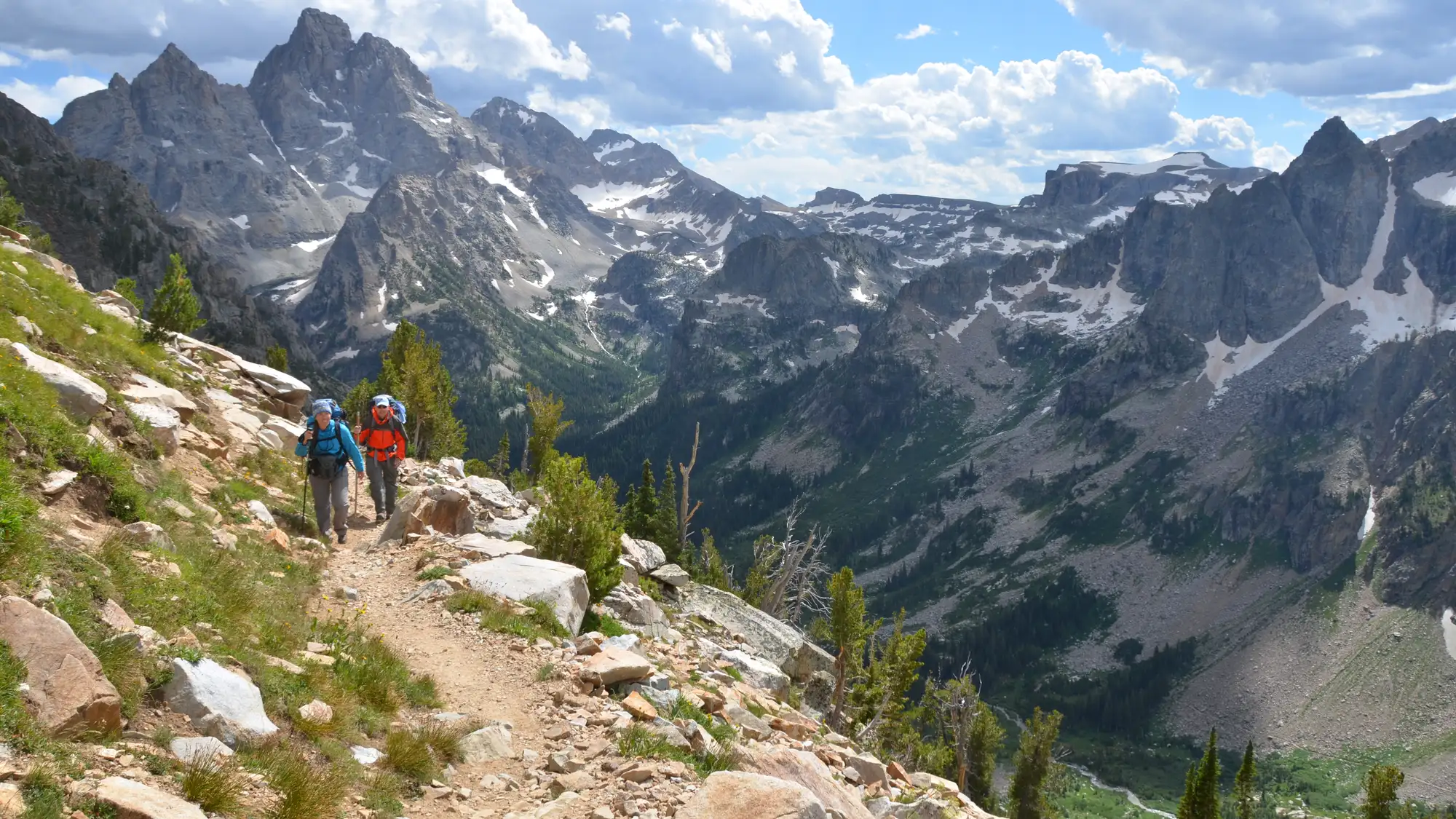
The Teton Range does something few mountains do. It rises straight off the floor of Jackson Hole with no foothills to soften the jump, so the peaks climb thousands of feet in one uninterrupted wall above pristine lakes like Jenny and Jackson. You are not easing into scenery here. You are standing under it.
That abruptness is the whole draw, and it changes how a walk feels. A loop around a lake or a climb toward Cascade Canyon puts steep alpine vistas in front of you the entire time, which keeps the body moving while the mind has somewhere effortless to rest.
The park backs this up with water, wildlife, and quiet the moment you leave the busiest trailheads. Bison, elk, and the sound of the Snake River are part of the experience, not scenery you have to go looking for.
The science: Researchers in Austria compared three hours of mountain hiking against three hours on an indoor treadmill at matched effort, and the mountain hike produced significantly larger gains in energy and pleasantness along with a sharper drop in fatigue. That indoor comparison is the useful part for a place like this: the same steps that carry you up toward Cascade Canyon or around Jenny Lake do more for how you feel than a machine can, because the mountain itself is part of what is working on you.
Niedermeier, Einwanger, Hartl & Kopp (2017) · PLOS ONE
Seasonal guide
Crowd levels use NPS monthly visitation, averaged 2015–2025. Excludes 2020 (COVID anomaly) and 2026 (partial year). Temperatures are NOAA climate normals from a station 6.4 miles away. Busy does not mean bad. If a peak month is your only window, the season notes below tell you how to work it.
December through February is the quietest stretch, with December drawing the fewest visitors all year. Daytime highs sit around 24F and nights fall near 0F, with snow blanketing the valley. Pack for frigid nights and short days, plan around plowed and winter-access routes, and you get the Tetons nearly to yourself.
Spring stays quiet in March and April before turning busy in May. Highs climb from the upper 30s in March to the mid 50s by May, with mild days, cold nights, and rain and snow trading off. Layer well, expect fast-changing conditions, and you catch the shoulder before summer fills up.
June through August is peak, and July is the single busiest month at over 700,000 visits. Warm days reach the mid to upper 70s with cool nights, and afternoon thundershowers are common. Start at dawn to beat lines and lots, and be off exposed high ground before storms build in the afternoon.
September and October stay busy before November empties into one of the quietest months. Highs drop from the mid 60s in September to the mid 30s by November, with sunny days, cold nights, and occasional early snowstorms. Bring warm layers and enjoy the thinning crowds as the season turns.
This month in the park
Timing changes everything out here. Pick a month to see when the light turns golden, which nights stay darkest for stargazing, and what visitors have actually recorded in bloom and on the move. The new-moon night is the one to plan a sky-watching evening around.
January 2027
Wildlife on the move · 28 species on record
- Moose 32 sightings
- American Bison 11 sightings
- Wapiti 6 sightings
- Ruffed Grouse 4 sightings
- Bighorn Sheep 4 sightings
February 2027
Wildlife on the move · 36 species on record
- Moose 39 sightings
- Bald Eagle 7 sightings
- Common Raven 5 sightings
- American Bison 5 sightings
- Trumpeter Swan 4 sightings
March 2027
In bloom · 2 species on record
- ❀ Sagebrush buttercup 1 sightings
- ❀ Indian Potato 1 sightings
Wildlife on the move · 52 species on record
- Moose 34 sightings
- Coyote 12 sightings
- Common Raven 9 sightings
- American Bison 9 sightings
- Red Fox 8 sightings
April 2027
In bloom · 5 species on record
- ❀ Yellow fritillary 5 sightings
- ❀ Sagebrush buttercup 4 sightings
- ❀ Longhorn steer's-head 2 sightings
- ❀ Spiny phlox 1 sightings
- ❀ Utah buttercup 1 sightings
Wildlife on the move · 76 species on record
- Moose 57 sightings
- Wapiti 25 sightings
- Uinta Ground Squirrel 23 sightings
- American Bison 17 sightings
- Mountain Bluebird 12 sightings
May 2027
In bloom · 55 species on record
- ❀ Yellow fritillary 78 sightings
- ❀ Arrowleaf balsamroot 49 sightings
- ❀ Longhorn steer's-head 18 sightings
- ❀ Utah Honeysuckle 16 sightings
- ❀ Ballhead waterleaf 10 sightings
Wildlife on the move · 253 species on record
- Moose 223 sightings
- Wapiti 177 sightings
- Uinta Ground Squirrel 147 sightings
- Yellow-bellied Marmot 129 sightings
- American Bison 98 sightings
June 2027
In bloom · 108 species on record
- ❀ Arrowleaf balsamroot 277 sightings
- ❀ Spotted fritillary 57 sightings
- ❀ Utah Honeysuckle 53 sightings
- ❀ Saskatoon 29 sightings
- ❀ Creeping mahonia 29 sightings
Wildlife on the move · 441 species on record
- Moose 323 sightings
- Yellow-bellied Marmot 269 sightings
- Uinta Ground Squirrel 199 sightings
- Wapiti 183 sightings
- Mule Deer 139 sightings
July 2026
In bloom · 114 species on record
- ❀ Fireweed 142 sightings
- ❀ Blue columbine 47 sightings
- ❀ Arrowleaf balsamroot 44 sightings
- ❀ Pipsissewa 31 sightings
- ❀ Silky Phacelia 28 sightings
Wildlife on the move · 522 species on record
- Moose 402 sightings
- Uinta Ground Squirrel 225 sightings
- American Bison 198 sightings
- Mule Deer 155 sightings
- Yellow-bellied Marmot 153 sightings
August 2026
In bloom · 95 species on record
- ❀ Fireweed 98 sightings
- ❀ Lewis' monkeyflower 32 sightings
- ❀ Pipsissewa 28 sightings
- ❀ Fringed Grass of Parnassus 27 sightings
- ❀ Musk thistle 18 sightings
Wildlife on the move · 417 species on record
- Moose 291 sightings
- Mule Deer 143 sightings
- American Black Bear 123 sightings
- American Pika 122 sightings
- American Bison 114 sightings
September 2026
In bloom · 38 species on record
- ❀ Western harebell 15 sightings
- ❀ Musk thistle 9 sightings
- ❀ Fireweed 9 sightings
- ❀ Pearly everlasting 7 sightings
- ❀ Sticky geranium 6 sightings
Wildlife on the move · 330 species on record
- Moose 334 sightings
- Mule Deer 129 sightings
- Spotted Tussock Moth 128 sightings
- American Red Squirrel 112 sightings
- American Black Bear 110 sightings
October 2026
In bloom · 9 species on record
- ❀ Western harebell 4 sightings
- ❀ Sticky geranium 2 sightings
- ❀ Scarlet Gilia 1 sightings
- ❀ Pearly everlasting 1 sightings
- ❀ Oxeye daisy 1 sightings
Wildlife on the move · 144 species on record
- Moose 138 sightings
- Wapiti 68 sightings
- American Bison 58 sightings
- Pronghorn 47 sightings
- Mule Deer 34 sightings
November 2026
Wildlife on the move · 51 species on record
- Moose 41 sightings
- American Bison 14 sightings
- American Red Squirrel 13 sightings
- Red Fox 9 sightings
- Common Raven 5 sightings
December 2026
Wildlife on the move · 24 species on record
- Moose 31 sightings
- American Bison 13 sightings
- Bald Eagle 4 sightings
- Mule Deer 4 sightings
- Ruffed Grouse 3 sightings
Sun and moon times are computed for the park's coordinates from standard NOAA solar equations and cross-checked against the U.S. Naval Observatory. Species lists are research-grade community observations for Grand Teton National Park, US, WY via iNaturalist, retrieved July 2026; sighting counts are all-time records for that calendar month.
Don’t wait for Grand Teton.
One big trip a year isn’t what changes how you feel — the small stuff in between is. The 7-Day Nature Reset is one tiny outdoor practice a day, wherever you already are. Day one takes 60 seconds.
No spam. No noise. Just nature.
Day 1 is landing in your inbox right now — go say hi.
Sleep nearby
Most visitors base in Jackson, Wyoming, about 12 miles out. Jackson is the area's largest town with far more rooms, diverse dining, and better prices than the park's immediate vicinity. Staying in Moose puts you at the entrance but it's a tiny community with only a post office and few amenities. The map opens on Jackson, so pan toward the park to trade rooms and price for a shorter morning drive.
Camping inside the park books through Recreation.gov and is listed separately.
The map is provided by Stay22. If you book through it we may earn a commission at no cost to you, which helps keep Happier Outdoors running. It never changes what we recommend.
Let someone else lead
A guide is worth it when the terrain needs one, or when you would rather look around than navigate. These are the highest-rated trips running around Grand Teton, not the cheapest.
 Free cancellation
 Sunrise 4-Hour Grand Teton Wildlife Adventure
- Up to 7 per booking
- Stroller accessible
 Free cancellation
 8 Hour Combination Snowshoe & Wildlife Viewing in Grand Teton National Park
- Up to 7 per booking
- Stroller accessible
 Free cancellation
 Private Full Day Wildlife Safari in Grand Teton National Park
- Runs Jun–Nov
- Private tour, up to 15
- Stroller accessible

Grand Teton Wildlife Safari in a Enclosed or Open-Air Vehicle (season dependent)
- Runs year-round
- Up to 12 per booking
- Service animals welcome
Tours are listed by Viator; booking happens there. If you book we may earn a commission at no cost to you, which helps keep Happier Outdoors running. It never changes what we list. Prices checked September 2026 and can change.
Activities & experiences
Beyond the trails
A quiet bend in the Snake River that gives you the Teton Range head on. Worth the stop.
This corridor road links the towns of Moose and Wilson.
The Outer Park Road runs past scenic views and overlooks. Good for a slow drive.
Watch for wildlife along the North Park Road, with wide views of Jackson Lake and the Tetons.
A dirt road running from Flagg Ranch to Ashton, Idaho.
Hugging the east shore of Jenny Lake, this drive puts the peaks right in front of you.
Details and current conditions live on nps.gov.
From the field
Common questions
When is the best time to visit Grand Teton National Park?
The quietest months with the mildest hiking weather are late spring and fall, while July and August bring the warmest days and the biggest crowds. Summer highs reach the mid 70s with cool nights and common afternoon thundershowers, so if you come in peak season, start early and plan around storms.
Is Grand Teton National Park dog-friendly?
Leashed dogs are allowed in campgrounds, picnic areas, parking lots, and along roads open to vehicles, but not on any hiking trail, in the backcountry, or on the multi-use pathway. Leashes must be no longer than six feet, and pets need to stay within 30 feet of a roadway at all times.
What is the quietest trail in Grand Teton National Park?
Visitors consistently point to trails away from the busy Jenny Lake corridor, including Two Ocean Lake on the east side, Death Canyon beyond Inspiration Point, Granite Canyon, and Hermitage Point. These stay quieter because they sit farther out, involve more elevation or rugged terrain, or are simply less advertised than iconic hikes like Cascade Canyon.
How crowded does Grand Teton National Park get?
It gets very crowded in summer, drawing over 3.4 million visits a year with July as the single busiest month. Crowds concentrate between about 9 AM and 2 PM at trailheads like Jenny Lake, where entrance lines and parking waits over 30 minutes are common.
Is Grand Teton National Park accessible for wheelchairs?
Yes, the park has several accessible trails with paved or firm surfaces plus accessible visitor centers, restrooms, and boat docks. Options include the paved Jenny Lake shore trails, the firm-gravel Laurance S. Rockefeller Preserve path, and the 16-mile paved multi-use pathway, and a beach wheelchair can be borrowed at Jenny Lake.
Can you camp at Grand Teton National Park?
Yes, the park has multiple developed campgrounds for tents and RVs, all of which now require advance reservations through Recreation.gov. Campgrounds include Colter Bay, Gros Ventre, Jenny Lake, Signal Mountain, and Lizard Creek, with most sites offering no hookups.
Where do you park at Grand Teton National Park?
Major trailhead lots at Jenny Lake and the Laurance S. Rockefeller Preserve fill early and can mean long waits during peak season, so arrive early. Roadside parking is prohibited when lots are full and can result in a ticket or towing, so plan alternate hikes if your first choice is packed.
How much does it cost to enter Grand Teton National Park?
Entry is $35 per private vehicle and covers seven days. Motorcycles are $30, and anyone entering on foot or by bicycle pays $20 per person, while an annual park pass is $70.